
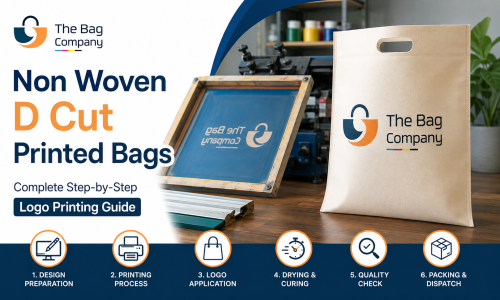
Brand visibility plays a significant role in product packaging and customer perception. Businesses across retail, exhibitions, food services, apparel, gifting, healthcare, and promotional campaigns rely on packaging that is practical while reinforcing their brand identity. Among the many options available, Non Woven D Cut Printed Bags have become a preferred choice because they combine durability, affordability, and attractive branding opportunities.
A professionally printed bag does much more than carry products. It acts as a moving advertisement, helping businesses gain exposure wherever customers travel. However, achieving a clean, vibrant, and long-lasting logo requires careful planning, proper material selection, and the right printing process.
This page explains every stage involved in logo printing, from artwork preparation to quality inspection, allowing businesses to make informed decisions before placing bulk orders. At The Bag Company, every production stage focuses on precision, consistency, and print quality to ensure bags reflect a professional brand image.
Why Logo Printing Matters on Non Woven Bags
Every printed shopping bag becomes an extension of a company’s marketing strategy. Unlike disposable packaging, reusable bags continue promoting a business long after the initial purchase.
Well-designed Non Woven D Cut Printed Bags offer several branding advantages:
- Improve brand recognition
- Create a professional business image
- Increase customer recall
- Encourage repeated exposure
- Support promotional campaigns
- Provide cost-effective advertising
- Enhance product presentation
Since customers reuse these bags multiple times, the printed logo reaches a wider audience without additional marketing expenses.
What Are Non Woven D Cut Printed Bags?
These bags are manufactured using non-woven polypropylene fabric that is bonded together without traditional weaving methods. The D-shaped die-cut handle provides a comfortable grip while maintaining an attractive appearance.
Their combination of strength and lightweight construction makes them suitable for:
- Retail shopping
- Fashion stores
- Grocery outlets
- Medical stores
- Corporate gifting
- Trade exhibitions
- Promotional events
- Educational institutions
- Jewellery packaging
- Cosmetic packaging
The smooth surface also makes them highly suitable for different printing techniques.
Step 1: Define the Branding Objective
Every successful printing project starts with a clear branding objective.
Businesses should identify:
- Primary target audience
- Logo placement
- Brand colours
- Promotional message
- Contact information
- QR codes
- Social media handles
- Website address
The overall purpose determines the printing layout and design approach.
For example:
- Retail stores often prioritize large logos.
- Event organizers may focus on sponsor branding.
- Corporate companies often prefer minimalistic designs.
Step 2: Select the Right Bag Size
Printing quality depends partly on selecting the appropriate bag dimensions.
Popular sizes include:
| Bag Size | Common Usage |
|---|---|
| Small | Jewellery, cosmetics |
| Medium | Apparel, books |
| Large | Grocery, exhibitions |
| Extra Large | Promotional kits |
Larger bags allow bigger logos and additional marketing information.
Step 3: Choose the Fabric GSM
The thickness of non woven fabric affects both durability and print appearance.
Common GSM options include:
- 60 GSM
- 70 GSM
- 80 GSM
- 90 GSM
- 100 GSM
- 120 GSM
Higher GSM provides:
- Better durability
- Improved print stability
- Reduced stretching
- Enhanced premium appearance
The fabric selection should match the intended application.
Step 4: Prepare High-Resolution Artwork
Artwork preparation is one of the most important stages.
Poor-quality artwork leads to:
- Blurred logos
- Pixelated graphics
- Colour inconsistencies
- Poor alignment
Professional artwork should include:
- Vector files
- High-resolution graphics
- CMYK colour format
- Correct dimensions
- Proper spacing
- Clear fonts
Preferred file formats include:
- AI
- EPS
- SVG
Vector artwork ensures sharp printing regardless of logo size.
Step 5: Finalize Brand Colours
Colour accuracy directly influences brand consistency.
Businesses should provide:
- Pantone colour references
- CMYK values
- RGB references (if required)
- Existing brand guidelines
Maintaining colour consistency across multiple production batches strengthens brand recognition.
Step 6: Select the Appropriate Printing Method
Different printing methods produce different results.
The right option depends on:
- Quantity
- Artwork complexity
- Colour count
- Budget
- Production timeline
Screen Printing
Ideal for:
- Bulk production
- Solid colours
- Large logos
Advantages include:
- Sharp printing
- Excellent durability
- Cost efficiency
- Consistent colour application
Flexographic Printing
Suitable for:
- Large production volumes
- Simple graphics
- Fast production
It offers consistent results with lower production costs.
Offset Printing
Offset printing is often selected when businesses require:
- Multi-colour graphics
- High-definition images
- Detailed artwork
- Premium branding
Digital Printing
Digital printing works well for:
- Small production runs
- Personalized designs
- Variable data
- Quick sampling
It provides flexibility while maintaining excellent image quality.
Step 7: Print Layout Approval
Before production begins, manufacturers prepare a digital proof.
This approval stage confirms:
- Logo placement
- Colour accuracy
- Font size
- Spacing
- Alignment
- Printing dimensions
Any corrections should be completed before mass production starts.
Step 8: Prepare Printing Screens or Plates
Depending on the selected printing method, production teams prepare:
- Screen frames
- Printing plates
- Ink rollers
- Digital setup
Accurate setup minimizes production errors and improves consistency.
Step 9: Ink Selection
Choosing suitable ink significantly affects durability.
High-quality printing inks provide:
- Better adhesion
- Fade resistance
- Sharp colours
- Scratch resistance
- Improved longevity
The selected ink should be compatible with non woven polypropylene fabric.
Step 10: Surface Preparation
Before printing begins, the fabric surface is inspected for:
- Dust
- Moisture
- Oil residue
- Manufacturing defects
A clean surface improves ink adhesion and overall print quality.
Step 11: Printing Process
Once preparation is complete, printing begins.
Each bag passes through controlled printing equipment where the logo is transferred carefully onto the fabric.
Machine operators continuously monitor:
- Ink flow
- Registration
- Colour density
- Alignment
- Pressure
Consistent monitoring prevents printing defects.
Step 12: Drying and Curing
Freshly printed bags require proper drying.
This stage allows ink to bond securely with the fabric.
Proper curing helps prevent:
- Smudging
- Colour transfer
- Peeling
- Surface damage
Controlled drying conditions contribute to long-lasting print quality.
Step 13: Handle and Bag Inspection
After printing, every production batch undergoes inspection.
Checks include:
- Handle strength
- Stitch quality
- Bag dimensions
- Fabric finish
- Print placement
This stage ensures both functionality and visual appeal.
Step 14: Quality Control
Quality inspection covers several important areas.
Colour Consistency
Every production batch should maintain identical colours.
Registration Accuracy
Multi-colour designs require perfect alignment.
Print Adhesion
The printed logo should remain intact during regular use.
Fabric Inspection
Manufacturers examine:
- Surface defects
- Wrinkles
- Tears
- Contamination
Overall Appearance
Every bag should present a professional finish before packaging.
Step 15: Packaging and Dispatch
Finished bags are:
- Counted
- Folded
- Packed
- Labelled
- Prepared for shipping
Proper packaging protects printed surfaces during transportation.
Common Printing Mistakes to Avoid
Businesses can improve results by avoiding common errors.
Low Resolution Artwork
Always provide vector graphics.
Incorrect Colour Codes
Use official brand colour references.
Overcrowded Design
Too much information reduces visual impact.
Poor Logo Placement
Maintain balanced spacing.
Ignoring Print Area Limits
Respect safe printing margins.
Choosing the Wrong Printing Technique
Different projects require different production methods.
Design Tips for Better Brand Visibility
Professional layouts often include:
- Large readable logo
- Minimal text
- Strong colour contrast
- Balanced spacing
- High-quality graphics
- Consistent typography
- Clear contact details
Simple designs often create stronger brand recall than crowded layouts.
Industries That Use Non Woven D Cut Printed Bags
These bags serve businesses across many sectors.
Examples include:
- Retail stores
- Supermarkets
- Fashion brands
- Medical suppliers
- Pharmacies
- Corporate offices
- Educational institutions
- Food businesses
- Jewellery retailers
- Cosmetic companies
- Trade exhibitions
- Promotional agencies
- Gift shops
- Electronics retailers
Their versatility makes them suitable for both promotional and everyday commercial applications.
How to Maintain Print Quality During Storage
Proper storage extends the life of printed bags.
Recommended practices include:
- Store in a dry environment.
- Keep away from direct sunlight.
- Avoid excessive humidity.
- Protect from dust.
- Stack carefully to prevent pressure marks.
- Maintain moderate temperatures.
Following these practices helps preserve colour vibrancy and overall appearance.
Why Businesses Prefer Professional Manufacturers
Experienced manufacturers maintain quality throughout production by combining advanced machinery, skilled operators, and strict inspection processes.
Working with an established supplier helps businesses receive:
- Consistent printing quality
- Reliable colour matching
- Accurate production timelines
- Durable materials
- Professional finishing
- Bulk manufacturing capability
- Custom sizing options
- Technical printing support
At The Bag Company, attention to detail at every production stage ensures that each order of Non Woven D Cut Printed Bags meets branding expectations while delivering dependable performance. From artwork verification and printing setup to quality inspection and final packaging, every step is managed with precision to produce bags that leave a lasting impression and support long-term brand visibility.
Conclusion
A well-printed non woven bag represents much more than packaging. It strengthens brand identity, improves customer recognition, and extends promotional reach through repeated everyday use. Achieving excellent results depends on careful artwork preparation, appropriate material selection, the right printing method, skilled production, and rigorous quality control. Businesses that invest in professionally manufactured Non Woven D Cut Printed Bags gain packaging that combines durability, functionality, and consistent visual appeal, making every customer interaction another opportunity to reinforce their brand.
FAQs
Can Non Woven D Cut Printed Bags be customized with multiple colours?
Yes. These bags can feature single-colour, two-colour, or full-colour logo printing, depending on the selected printing process and artwork specifications.
What artwork format should be provided for logo printing?
Vector formats such as AI, EPS, PDF, or SVG are preferred because they maintain sharp edges, accurate scaling, and high print quality without pixelation.
How durable is the logo printing on Non Woven D Cut Printed Bags?
When high-quality inks, suitable printing techniques, and proper curing processes are used, the printed logo remains vibrant and durable under normal handling and repeated reuse.