
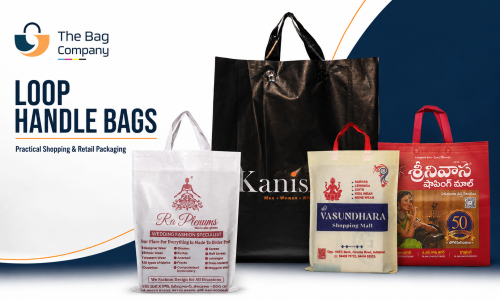
Packaging has a direct influence on product protection, customer convenience, brand presentation, and daily retail operations. Businesses need bags that can hold different items securely while remaining comfortable for customers to carry. They also require packaging that supports efficient billing counters, storage, distribution, and brand communication.
A loop handle bag meets these requirements through its simple yet functional construction. Its handles offer a convenient grip, while its spacious body accommodates products from clothing and cosmetics to groceries and promotional materials. Available in different dimensions, colours, thicknesses, and printing options, this bag can serve many commercial purposes without making the packaging process complicated.
What Is a Loop Handle Bag?
A loop handle carrier is a flexible shopping bag fitted with separate handles attached near the top opening. Manufacturers usually produce the handles from soft plastic strips and secure them to the bag using heat sealing or another reliable attachment method. The loop shape creates enough room for customers to hold the bag by hand or carry it over the forearm.
Unlike punched-out handles, loop handles extend above the bag body. This construction gives the carrier a distinctive retail appearance and preserves more space for printed designs. The handle also distributes pressure across a wider gripping area, which can improve carrying comfort when the bag contains multiple items.
Manufacturers can make these bags in various sizes and material thicknesses. Retailers can therefore select packaging according to product dimensions, expected weight, customer preferences, and branding requirements.
Why Is It Comfortable to Carry?
Carrying comfort remains one of the main reasons businesses select loop handles. A narrow or poorly designed grip may press against the fingers when a bag becomes heavy. Separate loop handles provide a broader and softer holding surface.
Customers often carry several purchases at once, particularly in supermarkets, shopping centres, exhibitions, and busy retail areas. Comfortable handles make the journey from the billing counter to a vehicle or public transport less inconvenient. Shoppers may also place the loops over their wrist or forearm when they need to keep their hands available.
Comfort may appear to be a small packaging detail, but it affects the customer’s overall impression. A bag that feels awkward, tears quickly, or becomes painful to hold can reduce satisfaction even if the purchased product meets expectations. Practical handles help create a more pleasant final stage of the buying process.
How Does the Handle Design Improve Strength?
The attached loop handle reinforces the area that receives the most pressure during carrying. Manufacturers can adjust the handle thickness and sealing method according to the intended load. When the material, handle, and seal work together correctly, the bag can support a useful range of retail products.
Weight does not remain concentrated around a small punched opening. Instead, the separate handle transfers pressure across its attachment points. This design can reduce stretching around the top of the bag and help the carrier retain its shape.
Actual load capacity depends on several factors, including:
- Bag dimensions and material quality
- Film thickness
- Handle width and thickness
- Seal quality
- Product shape and weight distribution
- Presence of sharp corners or edges
- Carrying and storage conditions
Retailers should never choose a bag based only on its outward size. A supplier should assess what the business intends to pack, the average order weight, and how customers will use the carrier.
Suitable for a Wide Range of Retail Products
Versatility makes this packaging format valuable across different sectors. Stores can use the same basic design while changing its size, colour, finish, or artwork to match particular products.
Fashion outlets can pack garments, scarves, accessories, and lightweight footwear. Cosmetic shops can use smaller designs for skincare products, personal care items, gift sets, and beauty accessories. Bookstores and stationery retailers can choose stronger versions for notebooks, office supplies, and educational products.
Supermarkets, bakeries, pharmacies, gift stores, mobile accessory outlets, trade fairs, and promotional campaigns can also use this format. Wider bags can accommodate bulky products, while compact versions can create neat packaging for smaller purchases.
This flexibility helps multi-category retailers reduce unnecessary packaging variations. They can maintain a small selection of sizes that covers most routine orders.
Efficient Packaging at Billing Counters
Retail packaging needs to perform well during busy trading hours. Staff should be able to open, fill, and hand over each bag without slowing the checkout process. Loop handles make the top of the carrier easy to identify and hold, which supports quick packing.
The bags can be organised in bundles near billing counters or packing stations. Employees can select the required size, insert the products, and lift the completed package by its handles. This straightforward process requires little instruction and works across supermarkets, apparel stores, exhibitions, and other high-traffic environments.
Easy handling can shorten small repetitive actions across hundreds of daily transactions. The resulting time savings may improve queue movement and reduce pressure on counter staff during peak periods.
Supports Clear Brand Visibility
Retail packaging often continues promoting a business after the customer leaves the store. A printed carrier can display a logo, brand name, message, contact information, website address, social media handle, or campaign artwork.
The handles sit above the main body rather than taking up a large cut-out section within it. This leaves a broad surface for visual communication. A well-planned design can make the business identity visible from both sides and from a reasonable distance.
Retailers may use a single colour for a clean, economical design or multiple colours for stronger visual impact. The best option depends on the brand identity, order volume, printing process, and budget.
The Bag Company helps businesses consider practical requirements alongside appearance. Attractive artwork works best when the bag size, print area, handle colour, and material specifications support its intended retail use.
Customisation for Different Business Needs
A standard carrier cannot suit every product or brand. Customisation allows businesses to select packaging that fits their operations more accurately.
Common options include:
- Different widths, heights, and gusset sizes
- Material thickness suited to the expected load
- Transparent, white, coloured, or opaque finishes
- Coordinated or contrasting handle colours
- Single-side or double-side printing
- Simple logo printing or detailed promotional artwork
- Glossy, smooth, or other available surface finishes
- Designs for seasonal sales, launches, and events
A fashion boutique may prefer a refined colour palette and a spacious print area. A supermarket may prioritise strength, quick packing, and multiple sizes. An exhibition organiser may need a lightweight branded bag for brochures, samples, and merchandise.
Custom specifications help each business balance presentation, function, and cost.
A Neat Appearance for Retail Presentation
The visual quality of packaging matters when customers purchase fashion, gifts, cosmetics, accessories, or premium products. A loop handle design creates a neat silhouette because the handles rise evenly from the top of the carrier.
Businesses can coordinate the handle with the bag colour or use contrast to attract attention. For example, a dark bag with bright handles may create a bold retail look, while matching colours can produce a more restrained appearance.
Printing should remain legible and properly positioned when the bag is filled. Important information should not sit too close to seals, folds, or edges. Experienced design and production teams can adjust the artwork to maintain balance across the printable surface.
Helps Protect Purchased Products
A retail carrier provides a temporary protective layer between the product and the external environment. It can help keep garments, packaged foods, printed materials, and other suitable items together while customers travel.
The flexible body adapts to different product shapes. An appropriately sized bag also reduces excessive movement inside the package. This can make items easier to organise and prevent smaller purchases from becoming separated.
Businesses must still match the carrier to the product. Sharp objects may require additional wrapping or stronger packaging. Hot items, liquids, fragile goods, and unpackaged food may need specialised materials or inner protection. Selecting the correct bag prevents avoidable damage and improves customer confidence.
Space-Efficient Storage and Transportation
Retailers often have limited storage space behind counters or in stockrooms. Flexible carriers generally occupy less room than rigid packaging when stored flat. Staff can keep large quantities in organised bundles and move them between branches or sales areas with relative ease.
Space efficiency also assists distributors and retailers managing multiple bag sizes. Clearly labelled cartons or bundles allow staff to identify dimensions and designs quickly. Proper storage protects the bags from dust, moisture, heat, direct sunlight, and accidental damage.
Businesses should estimate usage before ordering. Reliable consumption data helps prevent shortages during busy periods while limiting unnecessary stock accumulation.
Useful for Promotions and Events
Temporary campaigns often require packaging that combines utility with marketing. Retailers can print seasonal graphics, sale messages, event details, or product-launch branding on the carrier.
Trade show exhibitors can distribute catalogues, product samples, stationery, and small gifts in branded bags. Visitors can continue carrying the bag around the venue, increasing brand exposure among other attendees. Schools, healthcare organisations, property events, and corporate campaigns may use the same format for informational materials.
The bag provides value beyond decoration because recipients can use it immediately. Functional promotional items generally remain visible longer than leaflets that people may fold or discard.
Cost and Performance Balance
Packaging decisions should consider total value rather than the lowest unit rate alone. An inexpensive bag that frequently splits, stretches, or loses its handle can cause product damage, require double-bagging, and create customer complaints.
A properly specified loop handle bag can balance strength, appearance, carrying comfort, and production cost. Businesses should compare quotations using identical dimensions, thickness, handle specifications, material quality, printing coverage, order quantity, and delivery terms.
Order volume can affect pricing, particularly for customised production. Larger orders may reduce unit costs, but they also require more storage and careful demand forecasting. Retailers should choose quantities that align with their normal consumption, campaign schedule, and available stock space.
Factors to Consider Before Ordering
Selecting suitable retail packaging requires more than choosing a colour and adding a logo. Businesses should review how the bag will perform throughout its full use cycle.
First, identify the products that staff will place inside it. Record their typical dimensions, combined weight, shape, and packaging type. Second, decide whether one size can cover most transactions or whether the business needs several options.
Third, examine the artwork requirements. Determine whether the design needs one or two printed sides, how many colours it uses, and which details must remain prominent. Simple designs can often provide stronger visibility than overcrowded layouts.
Finally, request relevant samples or confirm performance specifications before placing a substantial order. Physical assessment allows the business to evaluate carrying comfort, handle attachment, dimensions, appearance, and suitability for actual products.
Responsible Use and Disposal Considerations
Packaging choices should reflect local waste rules, available recycling systems, material type, and intended reuse. No single disposal statement applies to every location because collection and processing facilities differ.
Businesses can encourage customers to reuse bags when the condition and application allow it. Clear disposal or recycling information should remain accurate for the material and the local waste system. Retailers should avoid vague environmental claims that they cannot substantiate.
Right-sizing also supports responsible packaging management. An excessively large or thick carrier may use more material than the product requires, while an underspecified bag may fail and require a second carrier. Accurate specifications help reduce both problems.
Why Retailers Value Consistent Packaging Quality
Consistency supports smooth store operations and protects brand credibility. A retailer expects every production batch to match approved dimensions, colour, handle strength, printing position, and general finish.
Variations can affect packing speed and customer perception. Handles that differ in length may feel awkward, while weak seals can lead to failure. Inconsistent colours may also make packaging appear unprofessional across multiple branches.
Businesses should work with a packaging supplier that communicates clearly about specifications, artwork approval, production quantities, tolerances, and delivery schedules. The Bag Company focuses on aligning the bag’s design with its practical purpose so retailers can maintain dependable presentation across routine sales and promotional campaigns.
Conclusion
Loop handle carriers combine comfort, useful strength, efficient storage, branding space, and adaptability within a straightforward packaging format. They can support fashion stores, supermarkets, cosmetic retailers, exhibitions, pharmacies, and many other commercial settings.
The best results come from selecting the correct dimensions, thickness, handle construction, and printing arrangement for the intended products. When businesses treat packaging as part of both customer service and brand communication, a loop handle bag becomes more than a carrier. It provides a practical connection between the checkout experience, product protection, and continued brand visibility.
Frequently Asked Questions
Are loop handle bags suitable for carrying heavy items?
Their suitability depends on material quality, film thickness, handle construction, seal strength, bag dimensions, and product shape. Stronger specifications may carry heavier retail purchases, but businesses should test the bag with actual products. Sharp, dense, or unusually heavy goods may require reinforced or specialised packaging.
Can businesses customise a loop handle bag?
Yes. Businesses can usually customise its dimensions, material thickness, colour, handle colour, print design, printing coverage, and finish. Available options may vary according to the manufacturing process and order quantity. Clear artwork and product details help the supplier recommend an appropriate specification.
How should a retailer choose the correct loop handle bag size?
The retailer should measure the width, height, and depth of its usual products and allow enough room for easy packing. It should also consider combined order weight, product shape, gusset requirements, handle comfort, and storage needs. Testing samples with real purchases can confirm the most practical size.